
The Ramayana is one of the two major ancient Indian epics, the other being the Mahabharata. It is attributed to the sage Valmiki and is believed to have been composed around 500 BCE to 100 BCE, though its exact date of composition is uncertain. The Ramayana consists of nearly 24,000 verses, divided into seven books or kandas.
The epic narrates the story of Prince Rama, the seventh avatar of the Hindu god Vishnu, and his journey to rescue his wife Sita from the demon king Ravana. The central narrative revolves around the exile of Rama, his wife Sita, and his loyal brother Lakshmana, which was orchestrated by his father King Dasharatha of Ayodhya. During their exile, Sita is abducted by Ravana, the demon king of Lanka, leading to Rama’s quest to rescue her with the help of an army of monkeys led by the monkey king Hanuman.
The Ramayana is not just a tale of adventure and heroism but also embodies profound moral, ethical, and philosophical teachings. It explores themes such as duty, loyalty, righteousness, sacrifice, and the battle between good and evil. Rama is portrayed as the embodiment of dharma (righteousness) and is revered as an ideal king, husband, and son.
The Ramayana has profoundly influenced Indian culture and spirituality for centuries. It has been retold and reinterpreted in various languages and forms of literature, including poetry, drama, and prose, across South and Southeast Asia. Additionally, the epic has inspired numerous artistic and cultural expressions, including dance, music, sculpture, and painting.
In Sri Lanka, the Ramayana holds significant cultural and religious importance. The island nation is deeply intertwined with the epic’s narrative, particularly through its connections with the character Ravana, the antagonist in the Ramayana.
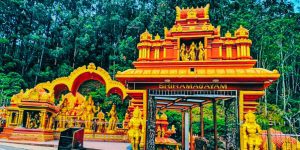
According to Sri Lankan tradition, Ravana is depicted as a powerful king who ruled over the kingdom of Lanka (present-day Sri Lanka). He is portrayed as a learned scholar, a devotee of Lord Shiva, and a master of various arts and sciences. The Ramayana story in Sri Lanka primarily focuses on Ravana’s abduction of Sita, the wife of Lord Rama, and the subsequent events that lead to a great war between Ravana and Rama.
Many sites across Sri Lanka are associated with episodes from the Ramayana. For example:
- Ashoka Vatika: Located in Nuwara Eliya, this is believed to be the place where Ravana kept Sita captive.
- Divurumpola Temple: Situated in Badulla, this temple is where Sita underwent the “Agni Pariksha” (trial by fire) to prove her purity after being rescued by Lord Rama.
- Ravana Ella Cave: A cave located in Ella, believed to be one of Ravana’s hideouts.
- Ravana Kanda: A mountain range in Sri Lanka believed to be named after Ravana.
These sites are not only significant pilgrimage destinations but also tourist attractions that attract visitors interested in the Ramayana’s legacy in Sri Lanka. Additionally, various cultural practices, rituals, and performances in Sri Lanka are influenced by the Ramayana narrative, further emphasizing its enduring impact on Sri Lankan culture and society.
Drop your inquiry to mail@ceylontastic.com for more information on tours.